Stake, trellis or moss pole: Give your houseplants support
In short
Has a long stem stretched well beyond its pot? Give a healthy climber a firm support and secure it with soft, loose ties. Match the support to its growth habit and weight. If the plant suddenly turns limp, assess the mix and its condition first – tying it up will not solve the cause.
In this guide
Is it climbing, or has it suddenly gone limp?
A firm stem that steadily grows longer may simply be following its natural growth habit. Many houseplants climb or trail. Adding a stake does not turn them into naturally upright plants.
If many leaves and stems suddenly droop, feel the potting mix. Both dry roots and damaged roots in wet mix can cause wilting. If wilt worsens while the root ball stays wet, use our guide to overwatering and root rot. A support is not a treatment for this.
Source: Iowa State University Extension: Why is my houseplant wilting?
Not every plant needs a moss pole
A pothos or heartleaf philodendron can trail from a secure shelf or hanging planter. If you want upward growth, you can train it onto suitable support. Wild pothos uses aerial roots to grip tree bark; these roots grow from the stem above the potting mix. Bushy philodendrons generally do not need climbing supports.
Slender, twining stems, such as those of indoor jasmine, can be guided around a hoop or trellis. They do not need a moss pole. Follow the species' growth habit and identify its supporting stem rather than pulling every leaf stalk into a bundle.
Source: Royal Horticultural Society: How to grow philodendrons
Stakes, trellises and moss poles do different jobs
A firm stake supports individual stems. A trellis or hoop gives you several attachment points for distributing long, flexible shoots. A heavy monstera needs a stronger structure than a small pothos; choose its height and strength with further growth in mind.
A moss pole also provides a moist surface that suitable aerial roots can grow into. Rough, coir-wrapped poles are another option. The material alone does not guarantee attachment: if the surface stays dry or roots cannot grip it, ties still carry the load. A support does not have to be moss-filled to hold a plant upright.
Make sure the support itself is secure first
The plant and support must not tip the pot over. A top-heavy monstera needs a stable container; a huge amount of extra mix is not a good solution. A large volume of unrooted mix that stays wet increases the risk of rot. Our repotting guide helps with size and drainage.
If repotting is needed anyway, plan room for the support. Set it firmly and deeply enough without piercing roots. On a monstera, the stem and its aerial roots should be able to reach it. Hold the root ball and keep the plant at its previous planting depth. Routine repotting is best done during active growth. Do not force a thick pole into a densely rooted pot: if there is no safe, secure position, postpone installation.
Source: Royal Horticultural Society: How to grow Swiss cheese plants
Tie the supporting stem and leave the leaves free
Wear gloves when handling monstera, pothos and philodendron, as their sap can irritate skin. Find the continuous stem from which the leaves grow. On a monstera, the long stalk from the stem to each leaf blade is a petiole; leave these free. Do not tie down an unfurling new shoot either.
Loop a soft fabric strip or suitable stretchy plant tie loosely around the stem and support. It should hold without leaving an indentation. For heavier stems, a figure-of-eight tie helps prevent rubbing: make one loop around the stem, cross the ends between stem and support, then loop around the support and knot there. Thin wire directly against a stem can cut into it.
Move a shoot only as far as it bends easily. Do not pull an old, stiff stem straight in one go; guide future growth instead. If the whole plant is too large, species-appropriate pruning is a separate decision from fastening it ever more tightly.
Source: Washington State University: Houseplants – Training, grooming and sanitation
A moist moss pole does not mean constantly wet potting mix
To let a suitable climber root into a moss pole, keep the pole's material moist. You can gently guide a monstera's aerial roots towards its surface. Leave rigid or already attached roots alone; healthy aerial roots do not need cutting off for the plant to be tied in.
Assess the pole and potting mix separately. A dry pole is not a reason to water an already wet root ball again. Catch runoff and empty the decorative pot. Our watering guide explains how to judge the plant's needs. If you do not want the additional job of keeping a pole moist, choose a simpler support with loose ties.
Source: University of Wisconsin–Madison Extension: Swiss-cheese plant, Monstera deliciosa
As the plant grows, its ties need attention too
Look for pressure marks when watering, and loosen tight loops. Inspect stretchy ties too: stems thicken and materials can become brittle. Add support for new shoots as needed. Before removing an old tie, hold the stem with your hand and see whether it is already firmly attached. Do not pull rooted growth away from the support.
If stems become unusually long and thin, with large gaps between small leaves, assess the light. A climbing support does not replace a suitable growing position. Our lighting guide explains what to do next.
Source: University of Maryland Extension: Lighting for indoor plants
Your checklist
Tick off what you have already checked. Nothing is saved.
Frequently asked questions
Can I leave my pothos trailing?
Yes. A suitable, stable or securely suspended position with appropriate light is enough. Longer stems alone do not mean it needs a climbing support. Keep them out of the way and where they will not be pulled down.
Must I repot straight away to add a support?
Not always. It needs a secure position with enough room to avoid unnecessary damage to the root ball. Do not force a thick pole through dense roots. If repotting is needed anyway, it is easier to plan room for the support then.
Will a moss pole automatically produce larger leaves?
Suitable support can encourage more mature growth in a climbing monstera. Light, age and the rest of its care still matter. A pole does not guarantee bigger leaves or more leaf splits.
When can I remove the ties?
There is no universal deadline. If the plant grips its support firmly, you can gently loosen individual ties and assess the attachment. A smooth stake may continue to need loose ties permanently.
Remember how you trained the stems
Save a photo in your Plantly journal after tying in the plant, with the support type and date. A later photo from a similar angle helps you see where new shoots have grown. Continue inspecting the actual ties on the plant.
Explore the related Plantly feature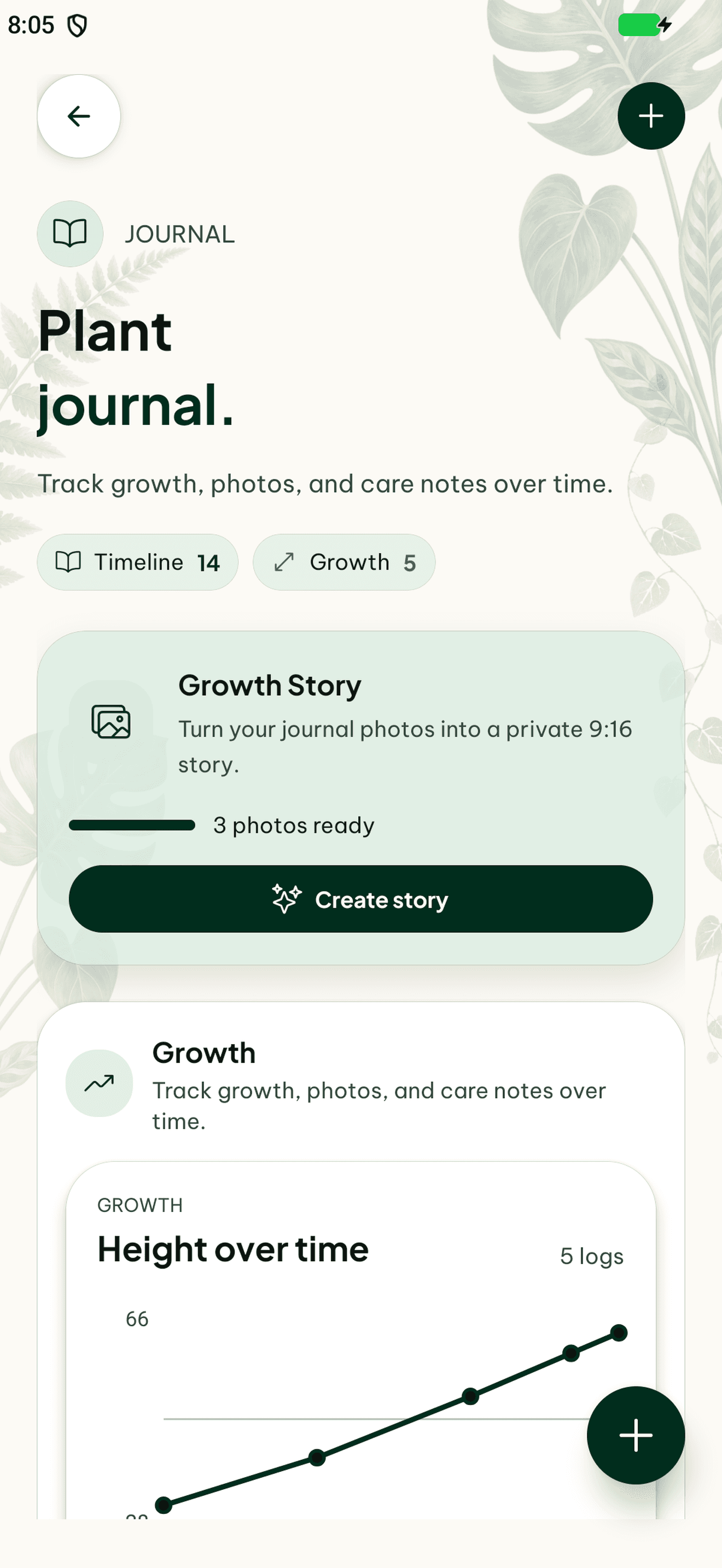

Sources
- Iowa State University Extension: Why is my houseplant wilting?yardandgarden.extension.iastate.edu
- Royal Horticultural Society: How to grow philodendronsrhs.org.uk
- Penn State Extension: Monstera as a houseplantextension.psu.edu
- Royal Horticultural Society: How to grow Swiss cheese plantsrhs.org.uk
- Washington State University: Houseplants – Training, grooming and sanitationextension.wsu.edu
- University of Wisconsin–Madison Extension: Swiss-cheese plant, Monstera deliciosahort.extension.wisc.edu
- University of Maryland Extension: Lighting for indoor plantsextension.umd.edu
Checked on 6 November 2026. This guide does not replace advice for your individual plant.