Pruning houseplants: What should you cut, and what should stay?
In short
Your pothos is trailing along the floor, while another plant has a brown leaf tip. Those call for different cuts. Shorten healthy stems only when needed and in a way that suits the species, preferably during active growth. Dead leaves can go. On true palms, leave the growing crown alone.
In this guide
What do you want the cut to change?
Do you want to shorten a stem, encourage branching or simply remove dead material? These are different jobs. A well-shaped houseplant does not need a routine all-over trim.
Cut a completely dead leaf off at its stalk without injuring the main stem. Do not pull it off. Be more cautious with leaves that still have green areas; there is specific advice for palms below.
Source: University of Maryland Extension: Grooming Indoor Plants
Wait for active growth before reshaping
Look at the shoot tips: are new leaves appearing? Light trimming fits an active growth phase. At an ordinary window, that is often spring or summer. If growth has slowed almost to a stop in the darker months, postpone a bigger reshaping job. You do not need to leave dead material in place while you wait.
Source: University of Georgia Extension: Growing Indoor Plants with Success
Use a sharp, clean blade rather than tearing stems
Choose sharp scissors for thin stalks and suitable pruners for firmer stems. Remove soil and plant debris from the blades. Disinfect before moving to another plant, especially after cutting suspicious or diseased tissue. UC IPM specifies 70 percent alcohol for this.
Follow the product instructions and keep alcohol away from flames. Wash your hands after removing diseased parts, too. Cutting is not a substitute for identifying soft, spreading rot.
On pothos, leave the leaf joint below your cut
Wear gloves: pothos can irritate skin. Find a node, the point where a leaf joins the stem. Cut just above it without damaging the node. It stays on the parent plant and can produce a side shoot.
Start with a few overlong stems and retain healthy foliage. Want to root the piece you removed? The cutting's lower end is prepared below a node: that is a different cut. Our stem-cutting guide walks you through what follows.
A brown tip does not call for removing the whole leaf
If a dry tip bothers you, trim just the brown part with clean scissors, following the leaf's outline. Leave a narrow dry margin rather than cutting into healthy green tissue. This improves appearance; it does not treat the cause.
If more tips turn brown, more trimming is not necessarily the answer. Our guide to brown leaf tips helps you work through possible care problems.
Source: Iowa State University Extension: Why does my houseplant have brown leaf tips and edges?
Topping a true palm will not make it shorter and bushier
A true palm's essential growing point sits at the top of each stem. Remove it with the crown and that stem will not branch from below like pothos. Keep green and partly green fronds; fully brown ones can be removed.
The RHS advises cutting old indoor palm leaves rather than pulling them. Avoid injuring the stem or emerging leaves.
Source: Naples Botanical Garden: Stop Paying Someone to Kill Your Palms
A flower spike is not a leafy stem
Do not apply the pothos method to every growth form. On a Phalaenopsis, a spent flower spike is different from the short main stem between the leaves. Whether to retain or shorten a green flower spike also depends on the plant's condition. Follow our moth orchid care guide after flowering rather than cutting off leaves or the growing crown.
Source: New York Botanical Garden: Phalaenopsis (moth orchid)
Afterwards, focus on the position, not an extra drink
Long, thin stems with widely spaced leaves can point to insufficient light. Pruning alone will not fix that. Our guide to light helps you choose a spot; choose according to the species, rather than assuming the sunniest window is best.
Continue watering according to the species and moisture in the pot, not automatically because you have pruned. Our watering guide helps with that decision. There is no need to feed just because you have pruned: feed in line with active growth.
Your checklist
Tick off what you have already checked. Nothing is saved.
Frequently asked questions
How much can I cut off at once?
There is no safe percentage for every houseplant. Species, growth form and condition matter. For a first reshaping, start with a few stems. A hard cut into bare woody growth needs species-specific guidance.
Does every yellow leaf need to come off immediately?
No. There is no rush to remove a leaf just because its colour changes, especially while healthy areas remain. If many leaves suddenly turn yellow or soft, investigate the cause first.
How often should I prune my houseplant?
When there is a reason, such as dead material or stems that have grown too long for the space. Keeping the natural shape is fine. One pruning date for the whole collection rarely makes sense.
A reminder is not an instruction to cut
Plantly's care calendar includes pruning. Record a cut when you have actually made it, or give feedback that care is not needed now. The reminder prompts you to look; it does not decide whether your plant can tolerate a cutback.
Explore the related Plantly feature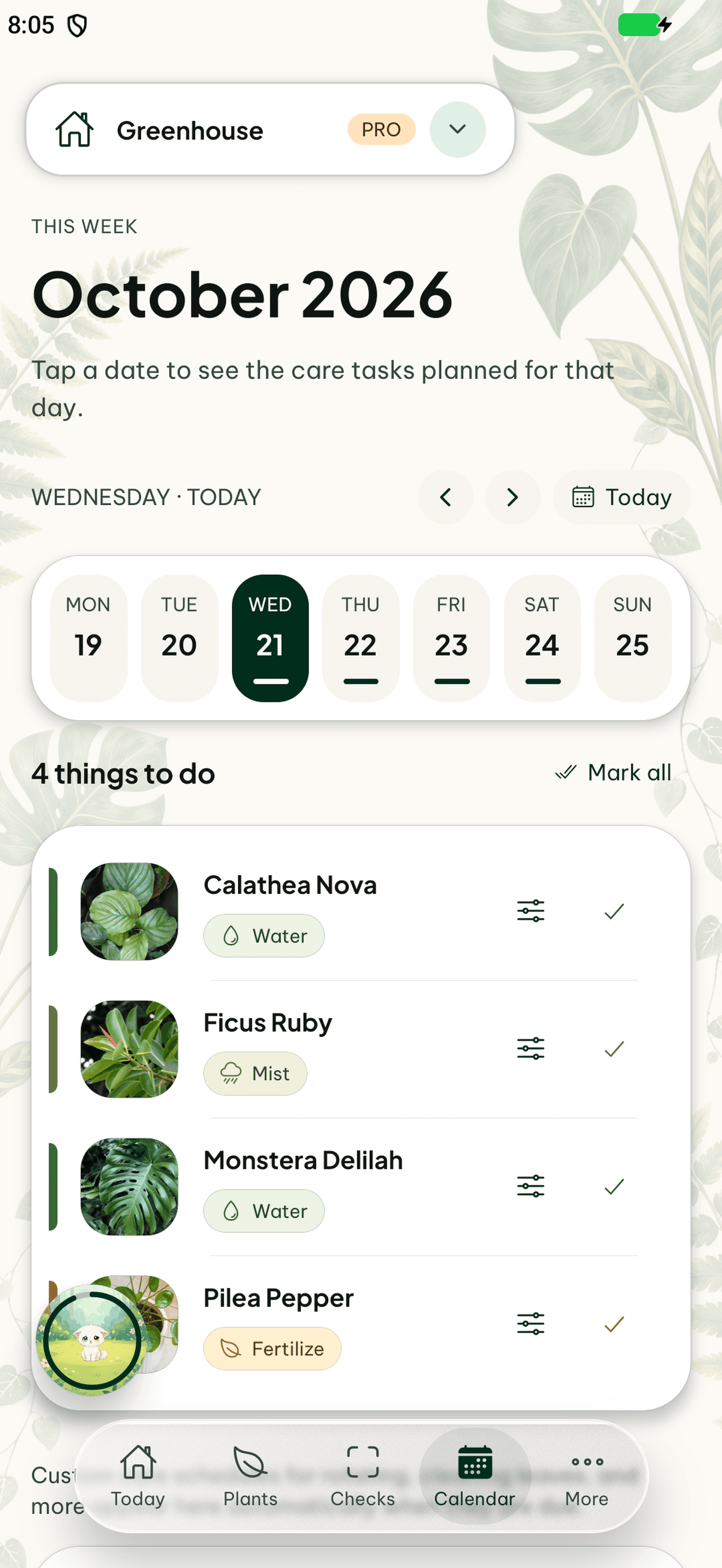
Sources
- University of Maryland Extension: Grooming Indoor Plantsextension.umd.edu
- University of Georgia Extension: Growing Indoor Plants with Successfieldreport.caes.uga.edu
- University of California IPM: Houseplant Problemsipm.ucanr.edu
- Royal Horticultural Society: How to grow epipremnumrhs.org.uk
- Iowa State University Extension: Why does my houseplant have brown leaf tips and edges?yardandgarden.extension.iastate.edu
- Naples Botanical Garden: Stop Paying Someone to Kill Your Palmsnaplesgarden.org
- New York Botanical Garden: Phalaenopsis (moth orchid)libguides.nybg.org
- Illinois Extension: Houseplant wateringextension.illinois.edu
Checked on 25 October 2026. This guide does not replace advice for your individual plant.