What is on your houseplant – and what should you do first?
In short
You spot sticky leaves or tiny moving dots while watering. Move the suspect plant away from the others, photograph what you found and take a closer look with a magnifier. Body shape, location and matching signs matter together. A yellow leaf alone is not a reason to reach for pesticide.
In this guide
Look before you wipe anything away
Move the pot away from the collection, without leaf contact, but keep it in suitable light and warmth.
Photograph the find before wiping it away. Look beneath leaves, at leaf joints, young shoots and buds, and around the pot rim and mix surface. A magnifier helps; inspect neighbouring plants too.
Source: Colorado State University Extension: Managing Houseplant Pests
Silvery marks or fine pale speckling?
Silvery streaks together with dark droppings and slender, elongated insects fit thrips. Look beneath leaves and inside tight folds. Our thrips guide helps you assess the signs and decide what comes next.
Lots of tiny pale specks with fine webbing point more towards spider mites. Look underneath for small, more rounded creatures; they need not be red. One stray spider thread is not enough. Follow our spider mite guide for a closer look.
White cottony clusters are different from attached scales
White cottony clusters with oval insects beneath them, especially where leaves join stems, fit mealybugs. Look into sheltered gaps without pulling young leaves apart. Our mealybug guide covers the next steps.
Scale insects often resemble small, firmly attached discs along veins or stems. Colour and shape vary between species. Do not scrape at every brown bump: have unclear specimens identified. Not all scale groups produce sticky honeydew.
Clusters on new shoots, or white insects beneath leaves?
Aphids often gather on soft new growth and buds. Legs and antennae are visible; the insects may be green, dark or brownish. Distorted young leaves and sticky deposits fit this pattern.
If small white insects flutter up when you move a leaf, look for whiteflies and their flat immature stages underneath. Unlike fungus gnats, they live mainly on foliage. A close-up of the plant is more useful for an uncertain identification than a fly caught elsewhere in the room.
Source: Pflanzenschutzdienst Hessen: Blattläuse an Zimmer- und Kübelpflanzen
Tiny flies around the pot, or jumping dots on the mix?
Delicate, dark flies walking over damp potting mix or flying close to the pot fit fungus gnats. Their larvae live in the mix; sticky cards catch only flying stages. Our fungus gnat guide helps you identify them and review watering appropriately.
Pale or grey dots jumping on the surface after watering may be springtails. They mainly feed on decaying material and usually do little or no harm to houseplants. Do not rush to dry a moisture-loving plant out completely.
No matching pests found? Do not spray on a guess
Stickiness alone does not identify a pest. Honeydew, the sugary waste of sap-feeding insects, is a clue, but plants can also release sticky substances themselves. A white coating is not necessarily an insect colony either.
Compare surfaces and coatings with our leaf-cleaning guide. If you find no pests or clear signs, review water, light and recent changes. For more widespread yellowing, see our guide to yellow leaves. Return to suspicious areas later; one unsuccessful search does not prove a plant is pest-free.
Source: Royal Horticultural Society: Leaf damage on houseplants
Remove confirmed pests gently, then look again
Wipe reachable, confirmed pests from sturdy smooth leaves with a soft damp cloth, or rinse carefully. Support the leaf, change to a clean cloth surface and avoid soaking the pot unnecessarily. For hairy or sensitive surfaces, follow our leaf-care guide.
Wash your hands and equipment afterwards. Keep the plant separate and look again for living pests and fresh damage. One wash does not mean treatment is finished.
Source: Mississippi State University Extension: Insect Pests of Houseplants
Confirm the problem before choosing treatment
If identification remains unclear or the infestation worsens, take photos of the whole plant, leaf undersides and the creatures to a knowledgeable plant adviser. Removing a badly damaged plant with persistent pests may be more sensible than trying further treatments on a guess.
If a pesticide is needed, products used in Germany must be authorised for non-professional users. Also check the plant, pest and place of use on the current label. Elsewhere, follow local requirements. Follow the instructions and precautions; do not add homemade detergent, alcohol or oil mixtures.
Source: Bayerische Landesanstalt für Landwirtschaft: Pflanzenschutz im Haus- und Kleingarten
Your checklist
Tick off what you have already checked. Nothing is saved.
Frequently asked questions
Should I treat every plant straight away?
No. Inspect the neighbours first and separate affected plants. Treating the whole collection is not an automatic precaution; it needs to fit the confirmed problem and chosen method.
Is a yellow sticky card enough for identification?
It shows flying insects moving near it. Mites, many immobile stages and hidden pests will not be caught. An empty card is not reliable proof that the plant is clear.
When can the plant go back with the others?
Not simply because it looks clean. Keep it separate while you find living pests or new suspicious signs. How long follow-up inspections and treatment are needed depends on the pest and its life cycle.
A useful health check starts with a clear picture
Plantly's guided health check combines photos and symptoms with saved plant context. Include the leaf underside where possible and describe whether the dots move. The suggestions help you assess what you see, but are not a verified pest identification.
Explore the related Plantly feature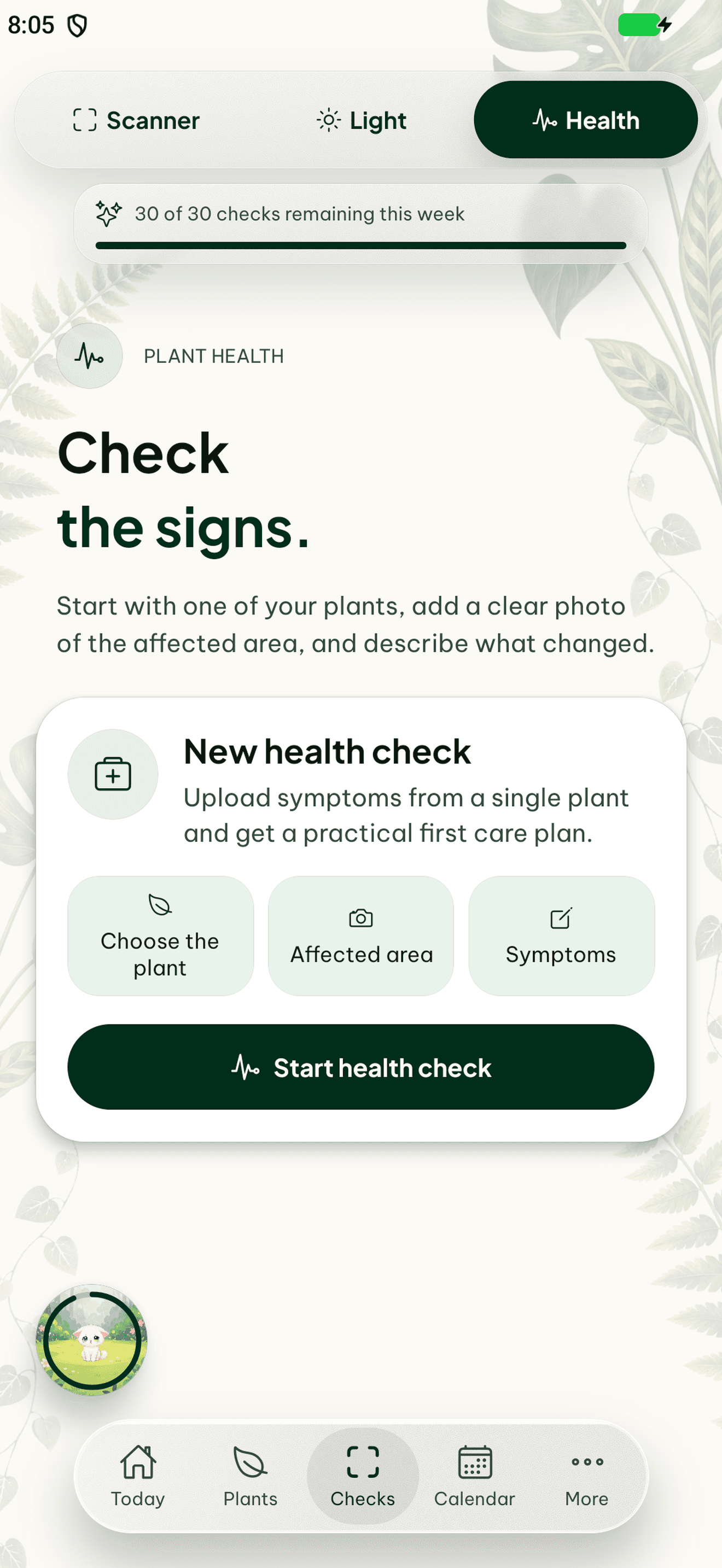

Sources
- Colorado State University Extension: Managing Houseplant Pestsextension.colostate.edu
- University of California IPM: Houseplant Problemsipm.ucanr.edu
- Royal Horticultural Society: Mealybugrhs.org.uk
- Pflanzenschutzdienst Hessen: Blattläuse an Zimmer- und Kübelpflanzenpflanzenschutzdienst.rp-giessen.de
- Royal Horticultural Society: Fungus gnatsrhs.org.uk
- Royal Horticultural Society: Leaf damage on houseplantsrhs.org.uk
- Mississippi State University Extension: Insect Pests of Houseplantsextension.msstate.edu
- Bayerische Landesanstalt für Landwirtschaft: Pflanzenschutz im Haus- und Kleingartenlfl.bayern.de
Checked on 26 October 2026. This guide does not replace advice for your individual plant.