Windows, radiators and drafts: How warm is your plant’s actual spot?
In short
The room feels comfortable, but the air beside the window feels chilly? The temperature around the plant matters more than the temperature by the sofa. Measure at its spot, keep leaves off cold glass and avoid blasts of hot or cold air. A slightly cooler evening is normal for many plants; abrupt changes and the species’ cold tolerance matter more.
In this guide
Comfortable room temperature is not a rule for every plant
For many common foliage plants, roughly 18–24 °C during the day is a useful starting point. It is not a survival limit or a required range for every species. A bright living room may suit a plant; an unheated stairwell will not automatically do so.
Look up the botanical name: the RHS suggests 16–21 °C for calatheas, for example. Flowering plants and species needing a cool rest may have different requirements. Your particular species takes priority over a general houseplant number.
Your thermostat does not know the windowsill
Place a minimum-maximum thermometer at the plant’s location, around leaf height and out of direct sun. It records the lowest and highest readings since being reset. Read it in the morning and after a typical day; repeat when heating or weather changes.
Notice what happens there: is a door opened frequently? Does the heating switch off at night? Is the pot in an air conditioner’s airflow? This helps you identify the troublesome part of the day rather than moving the plant based only on how warm the room feels.
Source: University of Arizona Cooperative Extension: Indoor plant selection and care
Window light is useful; contact with cold glass is not
Keep foliage from resting against cold glass. When you close the curtains at night, do not trap the plant in a cold pocket between fabric and window. Adjust its position without losing suitable light; our guide to light for houseplants can help.
A fixed distance in centimetres would not help much here: windows, insulation and outdoor temperatures differ. Take readings at the new spot.
Source: Royal Horticultural Society: How to grow houseplants
Avoid hot airflow, not every normal temperature change
Leaves directly above a radiator or in front of a fan heater receive hot, dry air. Move the plant out of that flow; in summer, keep it out of cold air blowing from an air conditioner too.
A night a few degrees cooler is fine for many houseplants if the range suits the species. You do not need to correct every ordinary fluctuation. If dry air is also an issue, see humidity for houseplants — extra watering cannot replace a better location.
Source: University of Maryland Extension: Temperature and humidity for indoor plants
You can still open the windows
Keeping every window shut to protect plants is not a good solution. Ventilate according to your home’s needs. In cold weather, opening windows fully for a short period is generally more useful than leaving one tilted open.
Move sensitive plants out of the direct cold airflow while you ventilate, or use a different window. Return them to a suitable bright position afterwards. A sheltered permanent spot makes this easier. Ventilation time depends on the room, weather and rate of air exchange.
New damage? Look at the sequence before acting
Yellowing or falling leaves can follow a temperature change, but do not prove draft damage. Note when you ventilated, used heating or moved the plant, and feel the potting mix. Wet and dry root balls can cause similar leaf responses. Our guide to leaf drop helps you follow those clues.
Move a stressed plant to a sheltered place that suits the species. Do not try to compensate for suspected cold exposure by putting it directly beside a heater. Decide whether to water from the mix, not from the urge to do as much as possible.
Source: Iowa State University Extension: Diagnosing houseplant problems from environmental conditions
Your checklist
Tick off what you have already checked. Nothing is saved.
Frequently asked questions
Is 18 °C too cold for every houseplant?
No. It suits some species, while others need more warmth or specifically benefit from cooler periods. The species and lowest readings at the plant’s location matter more than one room-temperature reading.
How far should my plant be from a radiator?
There is no reliable universal distance. Radiators, airflow and rooms differ. Choose a sufficiently bright spot outside the direct heat and measure there.
Does the temperature need to stay the same day and night?
Not for many plants. Normal day-night differences are not the same as a sudden cold blast. Keep conditions within the range suitable for the species.
Keep the actual spot with your plant
Give the plant an exact location in Plantly and keep your own minimum and maximum temperature readings in its journal. Add a note if you move it. Plantly does not measure room temperature.
Explore the related Plantly feature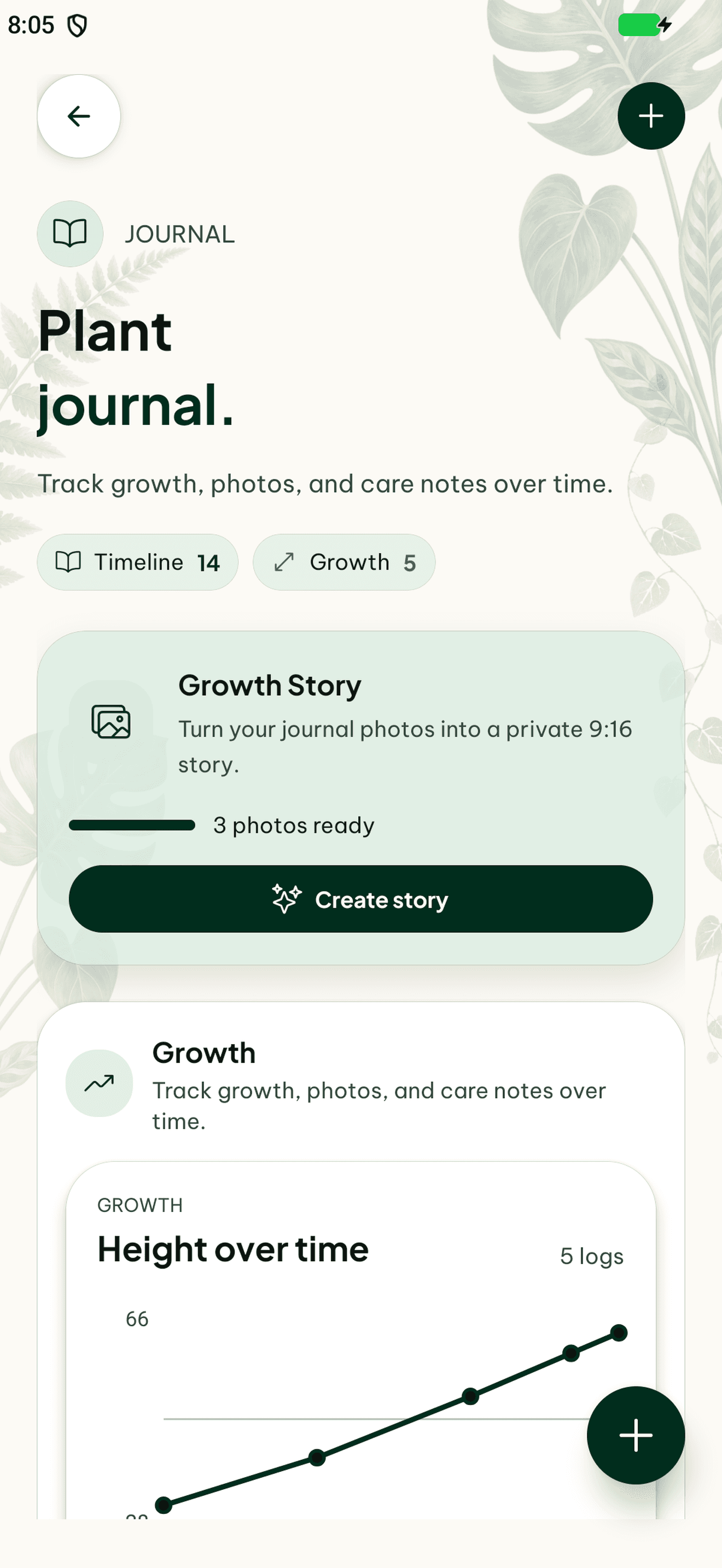
Sources
- Illinois Extension: Houseplant care — temperatureextension.illinois.edu
- University of Arizona Cooperative Extension: Indoor plant selection and careextension.arizona.edu
- Royal Horticultural Society: How to grow houseplantsrhs.org.uk
- University of Maryland Extension: Temperature and humidity for indoor plantsextension.umd.edu
- Umweltbundesamt: Wie lüfte ich richtig?umweltbundesamt.de
- Iowa State University Extension: Diagnosing houseplant problems from environmental conditionsyardandgarden.extension.iastate.edu
Checked on 24 October 2026. This guide does not replace advice for your individual plant.