How much humidity do your houseplants need?
In short
Crispy leaf tips, and the spray bottle is already in your hand? Measure the humidity first. Around 40–50 percent is a useful starting point for many houseplants, but different species have different needs. If the air stays too dry, a better location and, when needed, a humidifier do more than occasional misting.
In this guide
Not every plant needs rainforest air
Relative humidity tells you how close the air is to saturation with water vapour at its current temperature. The percentage therefore needs to be read alongside temperature. Around 40–50 percent is a starting point for many common houseplants, not a universal ideal.
Source: Iowa State University Extension: Raising humidity for houseplants
A calathea and a desert cactus need different treatment
Calatheas appreciate humid air. A bright bathroom may suit them, but a windowless one still lacks light. Look up your particular plant before increasing humidity throughout your home.
Many desert cacti and other drought-adapted succulents do not need extra humidity. Moist air cannot make up for a dim position either. Our guide to light for houseplants can help you choose a suitable spot.
Put a hygrometer beside the plant
A hygrometer measures air humidity. Place it at the plant’s location, away from direct mist or a water tray. Take morning and evening readings over several days, noting the temperature too. This helps distinguish a brief rise after a shower from conditions that last all day.
Source: Umweltbundesamt: Richtig lüften und Schimmel vermeiden
Brown tips do not prove the air is too dry
Feel the potting mix before adding water. Brown edges can also follow dry spells in the pot, fertilizer buildup or unsuitable water. If the mix stays wet, more watering will not fix dry room air. Our guide to brown leaf tips helps you tell these possibilities apart.
Source: Iowa State University Extension: Diagnosing houseplant problems
Improve the location before buying equipment
Move the plant out of hot air coming directly from a radiator or vent. Group humidity-loving plants loosely, leaving room for air to move between their leaves. A pebble tray may affect the air immediately around it, not the whole room. Keep pot bases above the water.
If readings remain too low for your plants, an adjustable humidifier is a more dependable option. Measure the result rather than continually adding moisture on guesswork. Use and clean the device according to its instructions.
Source: University of Maryland Extension: Temperature and humidity for indoor plants
A spray bottle is not a greenhouse
Misting raises humidity only briefly. You would need to repeat it constantly for a sustained effect, and continually wet leaves can encourage disease. Daily spraying is not a dependable main solution for dry room air.
Your home needs to stay dry too
Germany’s Environment Agency suggests roughly 40–60 percent for living spaces. That range does not guarantee freedom from mould: cold surfaces can be a problem even at lower room readings. Stop adding moisture if windows develop condensation or surfaces become damp. Ventilate as needed and find a more suitable spot for demanding plants rather than turning the whole room tropical.
Source: Umweltbundesamt: Richtig lüften und Schimmel vermeiden
Your checklist
Tick off what you have already checked. Nothing is saved.
Frequently asked questions
Does a reading of 35 percent mean I need a humidifier immediately?
Not necessarily. The species and other growing conditions matter. Several readings, the plant’s condition and a suitable location tell you more than one number.
Should I water more often when the air is dry?
Only if the pot actually needs water. Wet potting mix does not reliably raise room humidity and may damage roots.
Is the bathroom always the best place?
No. Extra humidity helps only when light and temperature also suit the plant. A brief rise after showering does not tell you what happens for the rest of the day.
Get to know the conditions beside your plant
Keep your own humidity and temperature readings as notes in Plantly’s plant journal, alongside any change of location. Plantly does not replace a hygrometer.
Explore the related Plantly feature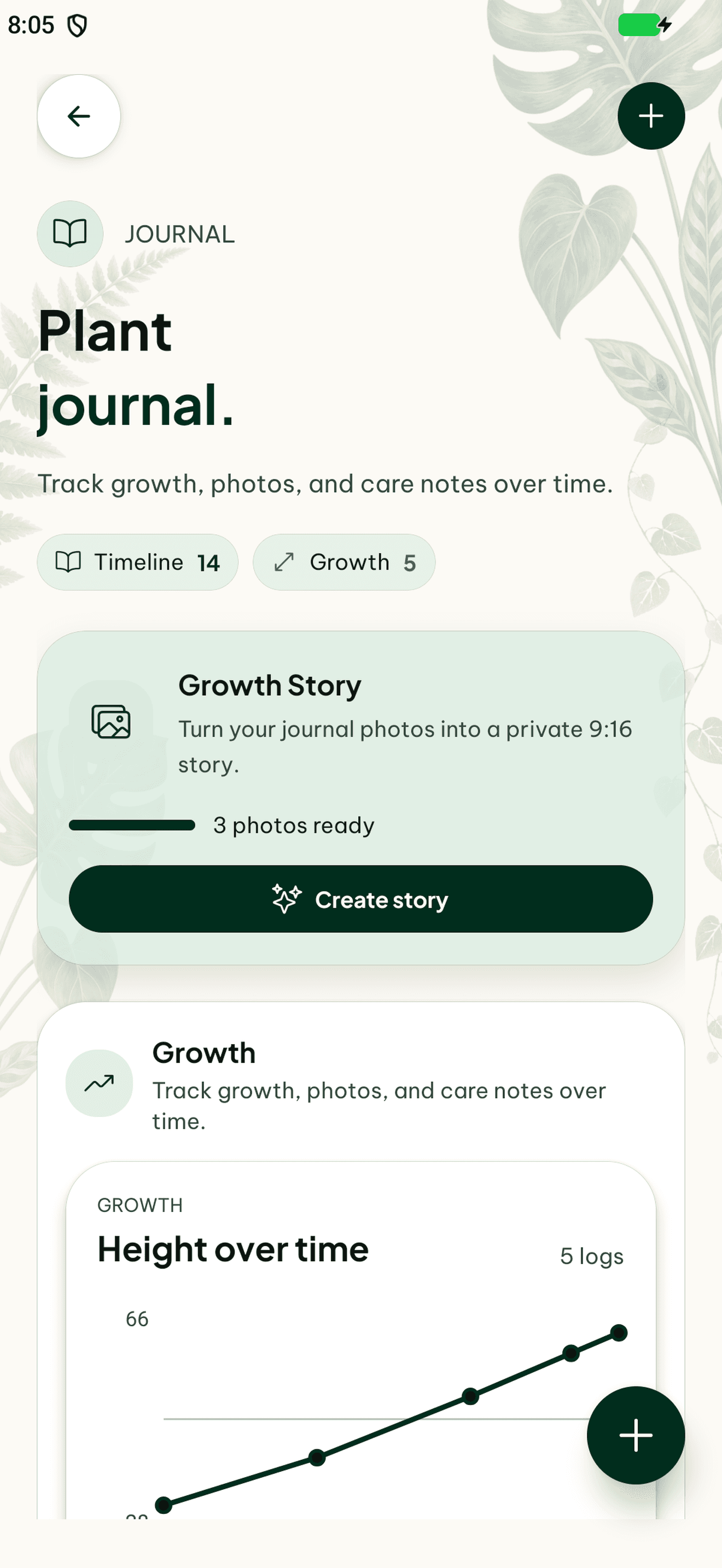
Sources
- Iowa State University Extension: Raising humidity for houseplantsyardandgarden.extension.iastate.edu
- Royal Horticultural Society: How to grow calatheasrhs.org.uk
- Umweltbundesamt: Richtig lüften und Schimmel vermeidenumweltbundesamt.de
- Iowa State University Extension: Diagnosing houseplant problemsyardandgarden.extension.iastate.edu
- University of Maryland Extension: Temperature and humidity for indoor plantsextension.umd.edu
- Illinois Extension: Houseplant careextension.illinois.edu
Checked on 23 October 2026. This guide does not replace advice for your individual plant.