How to set up a grow light for your houseplants
In short
A grow light helps when enough useful light reaches the leaves. Choose it for the plants and area, set its distance and daily light period, then observe new growth. Wattage or visible colour alone cannot tell you whether the setup works.
In this guide
1. Decide what the light needs to do
Will the light supplement daylight or supply everything the plant needs? Record the species, canopy area and goal: maintenance, vigorous growth or flowers. A setup for one small foliage plant will not automatically support several large pots.
Assess the whole area you want to illuminate. A shade-tolerant species and a plant with high light requirements need different conditions.
Source: University of Minnesota Extension: Lighting for Indoor Plants and Starting Seeds
2. Separate electricity use, colour and useful light
Watts describe electricity use; Kelvin describes the appearance of white light. Neither alone tells you much about the plant’s light supply. Lumens weight light according to human vision.
PPFD is more useful: usable light arriving at an area each second. Compare figures at stated distances and coverage areas. A peak reading beneath the centre does not describe the shelf edges.
Source: Iowa State University: Important Considerations for Providing Supplemental Light to Indoor Plants
3. Choose a fixture that fits the setup
LED grow lights are practical indoors. Look for a suitable spectrum, output and shape: a long fixture covers a shelf differently from a small spotlight.
Check mounting and adjustability. Plan watering so electrical parts stay dry. Fixtures and accessories must suit their location; a humid display cabinet creates different requirements from a dry shelf.
Source: Royal Horticultural Society: Artificial Lighting for Indoor Plants
4. Adjust distance and coverage together
Start with the manufacturer’s guidance. Moving closer usually raises intensity while potentially reducing coverage. There is no universal distance in centimetres.
Check the centre and edges, plus upper and lower leaves. Tall plants may need side lighting. Prevent contact between leaves and the fixture, check for heat and adjust the distance as plants grow.
Source: Iowa State University: How to Set Up Supplemental Lights for Indoor Plants
5. Consider intensity and running time together
For many foliage plants, roughly 12 to 14 hours of daily light is a useful starting point. Consider the period from first to last light; overlapping daylight and lamp hours are not counted twice. Match the setting to the species and actual intensity; running a very weak fixture longer will not automatically make it adequate.
Use a timer. When adjusting, change distance or duration first and record the setting.
Source: University of Minnesota Extension: Winter Houseplant Tips
6. Provide darkness and check flowering requirements
For routine houseplant care, a total light period of no more than 16 hours is a useful upper limit, not a target for every species. Include a night.
Poinsettia, kalanchoe and Christmas cactus need longer, uninterrupted dark periods to initiate flowers. Check their requirements for that stage separately. A shared timer programme can prevent the flowering you want.
Source: University of Maryland Extension: Lighting for Indoor Plants
7. Use measurements with realistic expectations
Measure at leaf level, not on the shelf or beside the fixture. Phone apps vary in accuracy and calculations; precise plant-related measurements need suitable equipment.
Compare settings using the same phone, orientation and similar daylight. One reading establishes neither adequate light across the day nor an exact PPFD value. Add manufacturer specifications and observations of growth.
8. Review the setup through new development
Photograph the starting condition and record the fixture, distance and duration. Then compare new leaves and shoots: already stretched stems will not shorten.
Weak new growth or pale damage after the change calls for reassessment. Adjust distance, positioning or duration if needed. Consider water and temperature too; a light cannot repair damaged roots.
Source: Iowa State University: How to Determine How Much Supplemental Light to Provide for Indoor Plants
Your checklist
Tick off what you have already checked. Nothing is saved.
Frequently asked questions
Must grow lights look purple?
No. Suitable white light works too; colour alone does not establish an adequate light supply.
Are 20 watts enough?
That depends on species, area, distance and output. Watts initially describe electricity consumption.
Should lights stay on continuously?
Include a daily dark period and account for particular flowering requirements.
Compare your artificially lit plant positions
Use Plantly's light check at the intended plant position as an initial guide, for example when comparing fixture positions. Also check manufacturer data, running time and new growth. A phone check does not replace precise PAR measurement or confirm adequate light across an entire day.
Explore the related Plantly feature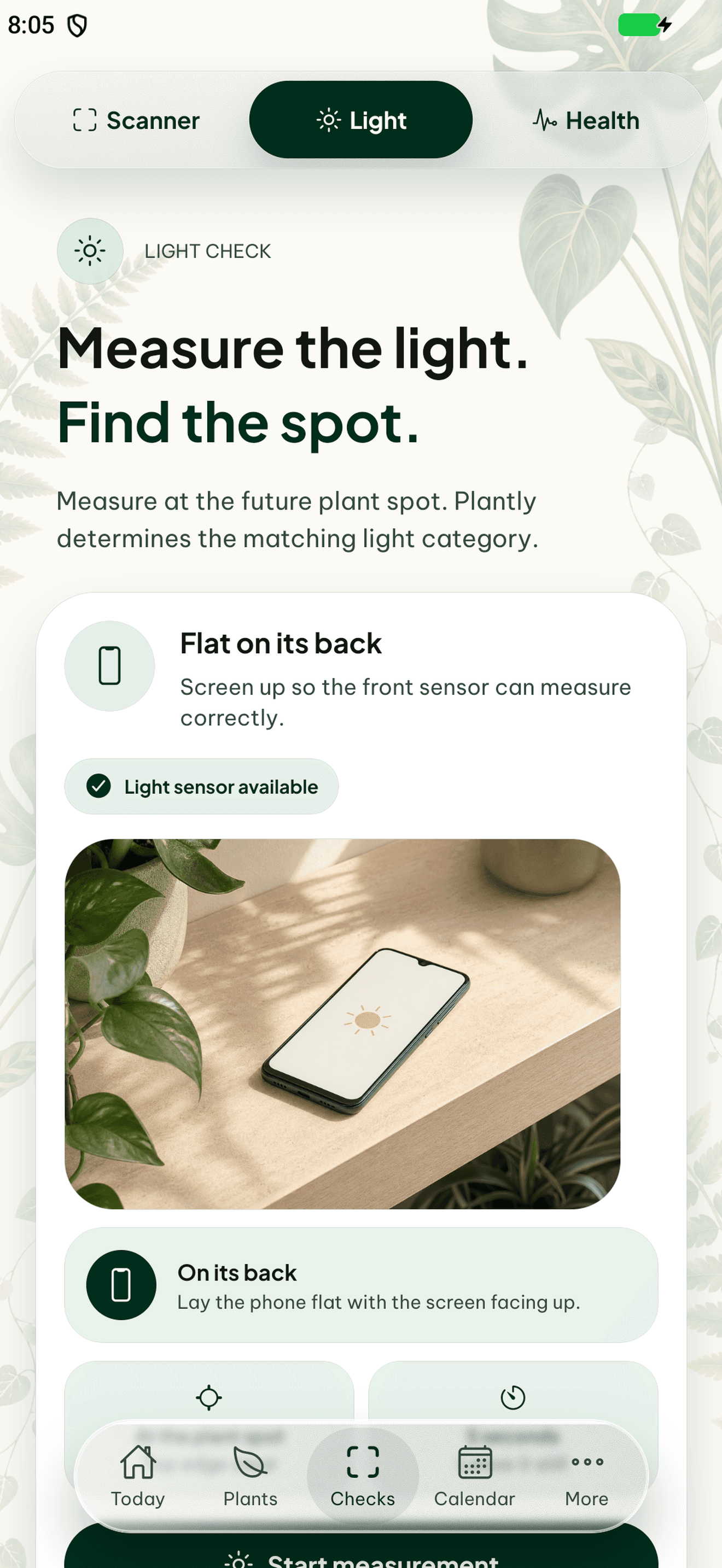
Sources
- University of Minnesota Extension: Lighting for Indoor Plants and Starting Seedsextension.umn.edu
- Iowa State University: Important Considerations for Providing Supplemental Light to Indoor Plantsyardandgarden.extension.iastate.edu
- Royal Horticultural Society: Artificial Lighting for Indoor Plantsrhs.org.uk
- Iowa State University: How to Set Up Supplemental Lights for Indoor Plantsyardandgarden.extension.iastate.edu
- University of Minnesota Extension: Winter Houseplant Tipsextension.umn.edu
- University of Maryland Extension: Lighting for Indoor Plantsextension.umd.edu
- University of Florida IFAS: Light for Houseplantsgardeningsolutions.ifas.ufl.edu
- Iowa State University: How to Determine How Much Supplemental Light to Provide for Indoor Plantsyardandgarden.extension.iastate.edu
Checked on 22 October 2026. This guide does not replace advice for your individual plant.